
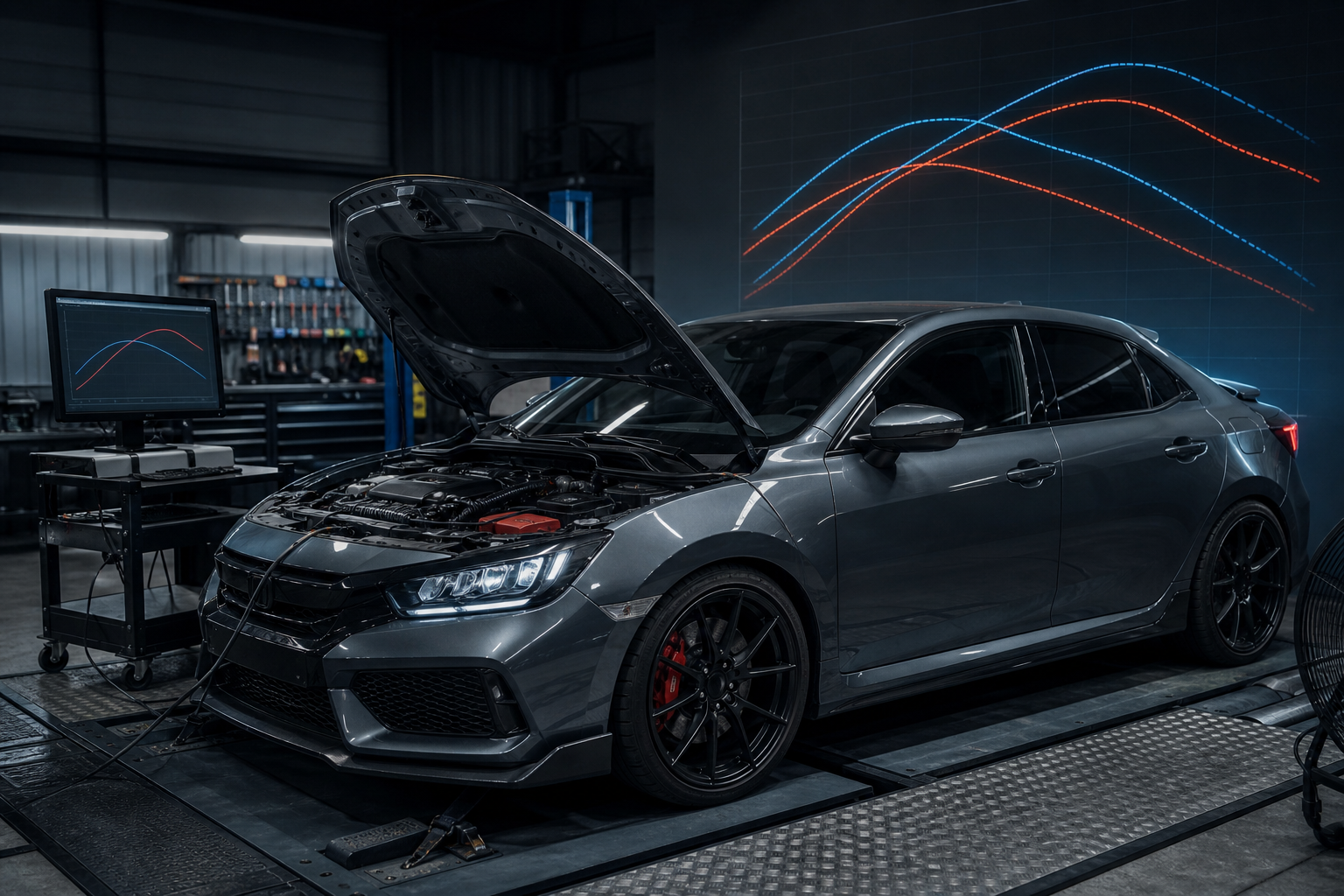
Stage 1 remap gains depend on the vehicle’s engine, hardware, condition, fuel and drivetrain—not simply its badge or stated factory power. Two apparently similar cars or vans can therefore have different safe tuning potential.
A Stage 1 remap recalibrates the existing engine management software while retaining the vehicle’s standard hardware. It may adjust parameters such as boost control, fuelling, ignition timing, throttle response and torque management, but it cannot remove the physical limits of the turbocharger, fuel system, cooling system or transmission.
For an initial vehicle-specific estimate, use Limited Edition Tuning’s Check Gains tool. Treat the displayed figures as a useful guide rather than a guaranteed result: the vehicle’s exact specification and mechanical health still need to be considered.
What determines Stage 1 remap gains?
The difference between standard and tuned output is often described as a simple power and torque increase. In practice, the achievable result is shaped by several connected factors.
| Factor | Why it matters | Possible effect on the result |
|---|---|---|
| Engine and hardware variant | Turbocharger, injectors, cooling components and internal specifications can differ between models. | Similar-looking vehicles may have different tuning limits. |
| Factory calibration | Some engines leave the factory with more unused hardware capacity than others. | A detuned variant may show a larger percentage increase. |
| Fuel | Fuel quality can affect combustion stability and ignition strategy. | The calibration may need to be matched to the fuel normally used. |
| Maintenance and condition | Restricted airflow, worn ignition parts, leaks and contaminated fluids can reduce performance. | Faults may limit output or make tuning unsuitable until repaired. |
| Transmission and clutch | The drivetrain must manage the additional torque produced by the engine. | Torque may need to be limited or delivered more progressively. |
| Testing conditions | Temperature, heat soak, fuel, tyres and measurement method influence recorded figures. | Results can differ between tests even when the calibration is unchanged. |
Engine variant and hardware specification
A model name or engine capacity does not identify every component fitted to a vehicle. Manufacturers may offer several power outputs based on the same broad engine family, but those variants are not automatically mechanically identical.
Differences can include:
- turbocharger size or specification;
- fuel injector and high-pressure pump capacity;
- intercooler and cooling-system performance;
- compression ratio and internal engine components;
- intake and exhaust design;
- emissions-control hardware;
- engine control unit and software version; and
- gearbox, clutch and driveline specification.
This is why a gain quoted for one engine code should not automatically be applied to another. Even where two vehicles have the same factory output, their model year, ECU software and supporting hardware can affect the appropriate calibration.
Factory detuning and available headroom
Manufacturers sometimes sell different power versions within the same engine family. Output can be separated through software calibration, hardware changes or a combination of both.
If a lower-output version genuinely shares suitable hardware with a more powerful derivative, it may have substantial calibration headroom. In other cases, the lower output may reflect a smaller turbocharger, different cooling equipment, a lower-capacity transmission or other physical differences.
Factory detuning should therefore be investigated rather than assumed. A large advertised increase is only meaningful if the exact engine and drivetrain can support it reliably.
Why turbocharged engines usually have more scope
Turbocharged petrol and diesel engines commonly offer more Stage 1 potential than naturally aspirated engines because the ECU can manage boost pressure as well as fuelling and torque demand. The available increase still depends on turbo efficiency, airflow, exhaust temperature, fuel delivery and cooling capacity.
A naturally aspirated engine has no turbo boost to recalibrate, so software-only gains are generally more limited. Improvements may be felt in throttle response, torque delivery or drivability without producing the same headline increase available from a suitable turbocharged engine.
The turbocharger’s condition is also important. Garrett Motion’s technical guidance highlights the role of clean oil, correct lubrication and unrestricted airflow in turbocharger performance and longevity. A remap should not be treated as a solution for oil contamination, boost leaks, restricted filters or a worn turbocharger.
Fuel quality can change the usable result
Petrol engines
Modern petrol ECUs use knock feedback to protect the engine. Bosch explains that a knock sensor reports abnormal combustion to the ECU, allowing ignition timing to be adjusted. If the fuel is less resistant to knock, the ECU may reduce ignition advance, potentially lowering performance.
A petrol calibration should therefore be matched to the fuel grade the owner can use consistently. Filling with higher-octane fuel does not automatically create extra power unless the engine and calibration are able to take advantage of it. Follow the fuel requirements agreed for the chosen map and never use fuel below the vehicle manufacturer’s minimum specification.
Diesel engines
For diesel vehicles, consistent fuel quality and a healthy injection system remain important. Injector correction issues, poor fuel pressure or restricted filtration can prevent the engine from delivering the expected torque cleanly and consistently.
Maintenance affects both the baseline and the gain
A vehicle that feels slower than expected may not be producing its original factory output. Adding a claimed percentage to the brochure figure can therefore create an unrealistic expectation.
Items that can affect the baseline include:
- blocked or heavily restricted air and fuel filters;
- worn spark plugs or ignition coils on petrol engines;
- boost, intake or vacuum leaks;
- injector or fuel-pressure problems;
- cooling-system faults or excessive intake temperatures;
- turbocharger wear or control problems;
- incorrect or overdue engine and gearbox fluids;
- DPF loading or unsuccessful regeneration;
- EGR, airflow, pressure or temperature sensor faults; and
- clutch slip or poor transmission operation.
ZF also notes that automatic-transmission oil ages more quickly under demanding operating conditions, including sporty driving and high temperatures. Engine tuning does not create a gearbox maintenance issue by itself, but extra torque makes the condition and suitability of the transmission more important.
Transmission and clutch limits can restrict torque
Peak torque is often the most noticeable part of a Stage 1 remap, particularly in a turbo-diesel car or van. It is also the figure most likely to expose a worn clutch or place additional demand on the gearbox and driveline.
Different vehicles—and sometimes different versions of the same model—can use different transmissions. ZF’s current 8HP family alone covers a broad torque range, demonstrating why identifying the precise gearbox matters more than simply describing a vehicle as having an eight-speed automatic.
A suitable calibration may manage torque by gear, engine speed or operating condition rather than requesting the maximum possible figure everywhere. This can produce a smoother and more usable result while respecting drivetrain limitations.
Where appropriate, gearbox software may also influence shift behaviour and torque management. Limited Edition Tuning lists DSG gearbox remapping among its tuning services, although suitability remains dependent on the individual vehicle.
Existing faults should be diagnosed before tuning
A remap should not be used to mask a mechanical or electronic fault. Warning lights, stored diagnostic trouble codes, irregular boost, excessive smoke, misfires, overheating, clutch slip or poor gearbox behaviour should be investigated first.
This matters because the ECU relies on sensor information to manage the engine. An inaccurate airflow, boost-pressure, fuel-pressure or temperature signal can cause inconsistent operation even if the software calibration itself is correct.
Some faults only appear under sustained load. A vehicle that behaves normally during gentle driving may still have a weak ignition component, boost leak or fuel-delivery problem that becomes apparent after torque demand increases.
Why quoted gains and measured gains can differ
Published Stage 1 figures are normally estimates based on a suitable, healthy example of the specified vehicle. Actual measurements can vary because of:
- the vehicle’s real standard output;
- fuel grade and fuel quality;
- ambient temperature and intake-air temperature;
- heat soak between test runs;
- tyre condition, pressure and traction;
- automatic gearbox behaviour during testing;
- drivetrain losses; and
- the type, setup and operation of the rolling road.
It is also important to compare like with like. Engine output, often called flywheel or crank output, is not the same as power measured at the wheels. Results from different measurement methods should not be compared without understanding how each figure was produced.
Peak figures do not tell the whole story
The highest power and torque numbers are only part of a remap’s effect. Two calibrations with the same peak figure can feel very different on the road.
Useful questions include:
- How early does the additional torque arrive?
- Is delivery smooth and progressive?
- Does performance remain consistent as temperatures rise?
- Is torque controlled in lower gears?
- Does the vehicle respond more cleanly during overtaking?
- Is the result appropriate for the clutch and gearbox?
For many road vehicles, a broad and controlled improvement in response is more useful than chasing the largest possible peak number.
How to interpret a Check Gains estimate
The Check Gains tool is a practical starting point when researching a Stage 1 remap. Select the correct make, model, engine and factory output wherever possible.
Before treating the estimate as applicable to your vehicle, confirm:
- the exact engine variant and standard output;
- the model year and ECU software where relevant;
- the gearbox or clutch fitted;
- whether the vehicle is standard or already modified;
- its maintenance history and current condition; and
- the fuel you normally use.
If you are also comparing the wider cost of tuning, read our guide to the factors that shape an ECU remapping quote in Sunderland.
Road legality, emissions and insurance
Vehicle modifications should remain roadworthy and compliant with applicable emissions requirements. The current DVSA MOT inspection manual treats manufacturer-fitted emissions-control equipment that is missing, obviously modified or obviously defective as a major defect where the relevant rules apply. A Stage 1 tune should not be viewed as a way to conceal a fault or bypass necessary repairs.
You should also tell your insurer about relevant vehicle modifications and confirm that cover remains valid. GOV.UK guidance recommends contacting the insurance provider to check whether changes affect motor insurance cover.
Discuss your vehicle’s realistic Stage 1 potential
The most useful Stage 1 estimate is based on the exact vehicle rather than a generic percentage. Begin with the Check Gains tool, then consider engine code, hardware, fuel, maintenance, existing faults and transmission condition before deciding how to proceed.
Limited Edition Tuning provides ECU remapping, tuning solutions and performance upgrades for cars, vans and performance vehicles in Sunderland. To discuss your vehicle and the type of result you want, contact Limited Edition Tuning.
Sources & further reading
- Bosch Mobility — Knock sensor
- Garrett Motion — Turbo oil leakage and failure causes
- Garrett Motion — Know your oil
- ZF — 8-Speed Automatic Transmission
- ZF Aftermarket — Transmission oil changes for passenger cars
- DVSA — MOT inspection manual: nuisance and exhaust emissions
- GOV.UK — Making changes to a vehicle