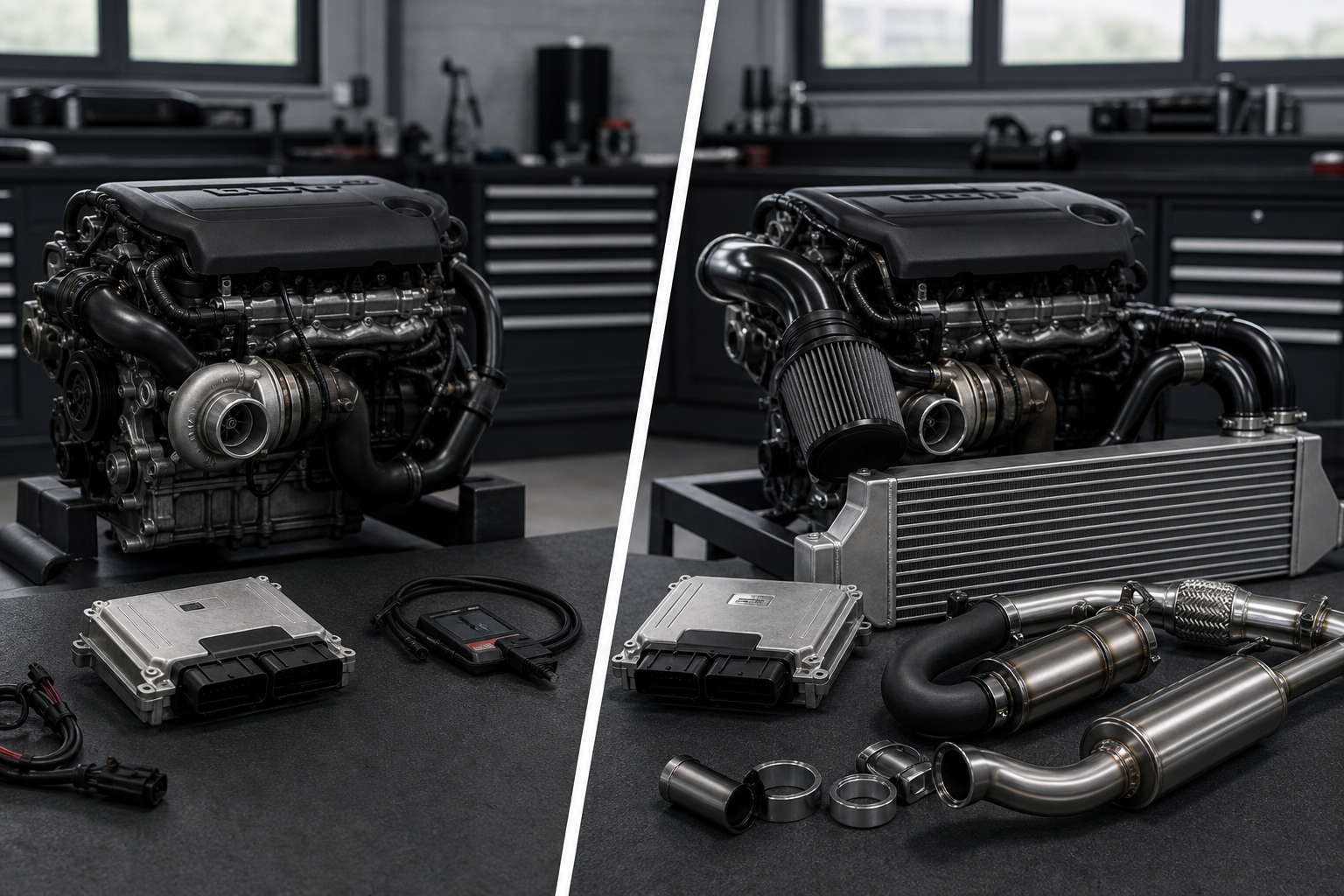
For most standard, road-driven cars, a Stage 1 remap is the more practical starting point. It is normally designed to work with the vehicle’s original hardware, provided the engine and transmission are in suitable condition.
Stage 2 is generally intended for vehicles with supporting performance parts. It can offer greater potential, but it also brings a higher overall cost, additional maintenance considerations and more questions about noise, emissions compliance and everyday usability.
Importantly, “Stage 1” and “Stage 2” are industry shorthand rather than universal technical standards. Requirements vary between tuners, engines and vehicle platforms. A quotation should therefore explain exactly what software, hardware and preparation your particular vehicle needs.
Stage 1 vs Stage 2 remap at a glance
| Consideration | Stage 1 remap | Stage 2 remap |
|---|---|---|
| Typical starting point | Healthy vehicle with standard engine hardware | Vehicle fitted with specified supporting upgrades |
| Hardware requirements | Usually none beyond properly functioning original components | May require intake, intercooler, exhaust, ignition, fuelling or transmission upgrades |
| Intended use | Daily driving, towing, commuting and improved drivability | Enthusiast road use or vehicles built around a defined performance goal |
| Total cost | Usually lower because fewer parts and less installation work are involved | Usually higher once parts, fitting, diagnostics and calibration are included |
| Maintenance demands | Relatively close to standard, although condition and servicing remain important | More attention may be needed for heat management, ignition, boost systems and drivetrain wear |
| Daily usability | Often the better balance for a road vehicle | Can remain usable, but the result depends heavily on the parts and calibration |
| Best choice when | You want a useful improvement without building a modified vehicle | You already have suitable hardware and understand the extra commitments |
What is a Stage 1 remap?
A Stage 1 remap recalibrates relevant ECU parameters while normally retaining the vehicle’s standard engine hardware. Depending on the engine, this can involve changes to boost control, ignition timing, fuelling, torque requests, throttle response and torque limiters.
The aim is not simply to chase the highest possible peak figure. A well-matched road calibration should deliver power and torque progressively, remain suitable for the available fuel and respect the practical limits of the engine, turbocharger, cooling system and transmission.
If you would like a clearer explanation of the software itself, read what an ECU remap actually changes.
Does Stage 1 require upgraded parts?
Stage 1 is usually associated with standard hardware, but that does not mean a car can be remapped regardless of its condition. Original components must be functioning correctly.
Issues that should be investigated before tuning may include:
- Boost or vacuum leaks
- Worn spark plugs or ignition coils
- Fuel-pressure faults
- Cooling-system problems
- Turbocharger wear
- DPF, catalyst or emissions-system faults
- A slipping clutch or transmission problem
- Stored or recurring diagnostic trouble codes
A remap should not be treated as a way to conceal an underlying mechanical fault. Increasing requested torque can make an existing weakness more noticeable.
Who is Stage 1 best for?
Stage 1 often suits drivers who want stronger mid-range response, easier overtaking and more flexible everyday performance without committing to a collection of aftermarket parts.
It may be appropriate for:
- A standard turbocharged petrol or diesel car used every day
- A van that would benefit from more usable torque, subject to vehicle condition and operating demands
- A driver who prioritises smoothness and drivability over a maximum output figure
- An owner who wants to keep noise levels and hardware close to standard
- Someone planning upgrades gradually rather than all at once
What is a Stage 2 remap?
A Stage 2 remap is normally calibrated around specific supporting modifications. Those parts are intended to address restrictions or operating demands that become more significant at a higher performance level.
There is no universal Stage 2 parts list. One engine may need improved charge-air cooling, while another may require changes to its intake, exhaust, ignition system or fuel delivery. The correct specification depends on the vehicle, engine code, existing modifications and intended use.
What hardware might Stage 2 require?
Depending on the vehicle, supporting hardware could include:
- A higher-capacity intercooler to help manage intake temperatures
- An upgraded intake or less restrictive inlet components
- An emissions-compliant performance exhaust or downpipe
- An appropriate road-legal catalytic converter
- Different spark plugs or other ignition-system upgrades
- Fuel-system components capable of meeting the requested demand
- An uprated clutch where the original unit cannot reliably manage the additional torque
- Transmission software calibrated for the revised torque output
Not every Stage 2 vehicle needs every item on this list. Parts should be selected to solve a documented limitation, not added simply because they appear in a generic package.
Who is Stage 2 best for?
Stage 2 is more likely to suit an owner who already has compatible performance hardware or has a clear plan for the completed vehicle. It can be appropriate where the driver understands that the project extends beyond uploading different ECU software.
It may make sense if:
- The vehicle already has the required supporting upgrades
- Stage 1 cannot meet the owner’s defined performance objective
- The cooling, braking, tyres and drivetrain are suitable for the intended use
- The owner accepts the additional servicing and inspection demands
- All parts and software will remain suitable for lawful road use
Why Stage 2 is not automatically better
A higher stage number does not automatically produce a better car. The most suitable tune is the one that matches the vehicle, its condition and how it is actually driven.
A responsive Stage 1 car on good tyres with healthy standard components may be more enjoyable and dependable on the road than a Stage 2 vehicle assembled from poorly matched parts. Peak output also tells you little about throttle progression, heat management, traction or how consistently the car performs.
Before choosing Stage 2, consider what Stage 1 is failing to provide. If there is no clear answer beyond wanting the higher label, the extra expense and complexity may not be justified.
How the costs differ
A Stage 1 quotation is generally centred on diagnostics, calibration and the tuning procedure. Stage 2 should be assessed as a complete upgrade rather than priced as software alone.
The Stage 2 budget may need to cover:
- Supporting performance parts
- Installation labour
- Replacement gaskets, clamps, fluids or other consumables
- Fault diagnosis and maintenance before tuning
- ECU calibration for the finished hardware specification
- Possible clutch or transmission work
- Tyre and brake improvements where appropriate
- Future inspection and maintenance of aftermarket components
The vehicle model, ECU type, engine condition and existing modifications can all shape the final quote. Our guide to ECU remapping costs in Sunderland explains why prices cannot be judged by the tuning stage alone.
Maintenance after Stage 1 or Stage 2 tuning
Any tuned vehicle still needs to follow the applicable manufacturer maintenance requirements. Its use and modification level may also justify additional checks or more conservative maintenance planning.
Areas worth monitoring include:
- Engine oil level, condition and correct specification
- Coolant level and cooling-system performance
- Spark plugs, coils and misfire history on petrol engines
- Boost hoses, intake joints and vacuum lines
- Turbocharger operation and unusual noises
- Clutch behaviour and transmission fluid requirements
- DPF regeneration behaviour on diesel vehicles
- Tyre condition, pressure and load rating
- Brake condition and fluid servicing
Stage 2 vehicles can place greater emphasis on temperature control and the condition of supporting parts. A larger intercooler, for example, may provide additional thermal capacity, but it does not compensate for a cooling fault, boost leak or unsuitable calibration.
What about the clutch, automatic gearbox or DSG?
Engine torque cannot be considered separately from the drivetrain. A clutch that holds the standard output may begin to slip after torque is increased, particularly if it is already worn.
Automatic and dual-clutch transmissions also have operating strategies and torque limits of their own. Depending on the vehicle, the engine calibration may need to remain within the gearbox’s suitable limits, or a compatible transmission remap may be considered.
This does not mean every remapped vehicle requires clutch replacement or gearbox software. It means the transmission’s type, condition and torque capacity should form part of the decision before an output target is agreed.
Stage 1 vs Stage 2 for daily driving
For commuting and mixed road use, Stage 1 will often provide the more useful balance. It can improve response and flexibility while retaining standard hardware and avoiding some of the noise, expense and complexity associated with a more extensively modified vehicle.
Stage 2 can still be calibrated for road use, but daily suitability depends on the complete specification. Consider cabin noise, cold-start behaviour, low-speed smoothness, traction, fuel availability and whether replacement parts will be easy to obtain.
Drivers should also be realistic about fuel economy. A torque increase may allow earlier gear changes in some situations, but using the added performance more frequently will increase fuel consumption. Neither stage should be chosen on the assumption that a particular saving is guaranteed.
Stage 1 vs Stage 2 for vans and towing vehicles
A van or tow vehicle benefits most from controlled, usable torque rather than an aggressive peak figure. Payload, towing weight, clutch condition, gearbox behaviour and exhaust-gas temperatures may all be relevant.
Stage 1 may be the more proportionate choice for a working vehicle because it can retain the standard hardware and focus on predictable delivery. Stage 2 should only be considered where the supporting parts and calibration are appropriate for sustained load, not merely short bursts of acceleration.
No remap changes the vehicle’s legal weight, towing or axle limits. Those limits must continue to be observed.
Insurance, MOT and road legality
An ECU remap is a vehicle modification and should be declared to your insurer. The Financial Ombudsman Service warns that undeclared modifications, including ECU remapping, can cause serious problems with insurance cover and claims. Contact the insurer before work begins so that you understand any change to the premium or policy terms.
Road-going vehicles must also remain roadworthy and compliant with applicable emissions and noise requirements. The current DVSA MOT inspection manual treats missing, obviously modified or defective manufacturer-fitted emissions equipment as a major defect in relevant vehicles. It also states that a modified engine must still meet the emissions requirements applicable to the vehicle.
A DPF fitted when a vehicle was manufactured must not be removed for road use. Government guidance on catalytic converters and diesel particulate filters confirms that a vehicle originally fitted with a DPF will fail its MOT if that filter is no longer present.
For a road car, a Stage 2 plan should therefore retain the necessary emissions-control equipment and use suitable, compliant components. Passing an MOT also does not remove the owner’s continuing responsibility to keep the vehicle roadworthy.
Modifications may affect manufacturer or aftermarket warranty coverage as well. Check the relevant warranty terms before authorising any work rather than assuming that every component will remain covered.
Questions to ask before choosing a tuning stage
A useful consultation should go beyond asking whether you want Stage 1 or Stage 2. Be prepared to discuss:
- How do you use the vehicle? Daily commuting, towing, commercial use and enthusiastic road driving create different priorities.
- What is its current condition? Service history and unresolved faults matter more than the stage label.
- Which hardware is already fitted? Provide accurate part details rather than relying on appearance.
- What fuel will you use? The calibration should be suitable for the fuel grade consistently available to you.
- What result do you actually want? Better response may not require the most powerful available option.
- Can the transmission manage the requested torque? Engine and gearbox requirements should be considered together.
- Is every component suitable for road use? Check emissions, noise, insurance and MOT implications before buying parts.
- Are you prepared for the total cost? Include installation, maintenance and potential supporting work rather than software alone.
Can you upgrade from Stage 1 to Stage 2 later?
In many cases, a vehicle can begin with Stage 1 and move to a higher specification after the correct supporting parts are installed. However, compatibility should be checked before purchasing hardware.
The later calibration must match the final parts fitted to the vehicle. Driving permanently with software intended for a different hardware specification can lead to poor operation or place components under inappropriate demands.
If Stage 2 is your eventual goal, planning the complete build early can prevent duplicated labour and unsuitable part purchases.
Which remap should you choose?
Choose Stage 1 if your car or van is mechanically healthy, largely standard and used mainly on the road. It is usually the logical option when you want improved power, torque and drivability without turning the vehicle into a larger modification project.
Consider Stage 2 if you have a clear performance objective, are willing to install the correct supporting hardware and understand the higher cost and maintenance commitment. It should be chosen because the specification suits the vehicle—not because Stage 2 sounds better than Stage 1.
Limited Edition Tuning provides Stage 1 and Stage 2 remapping for suitable vehicles in Sunderland. You can check potential gains for your vehicle, but any final recommendation should also consider its condition, transmission, current hardware and intended use.
If you are unsure which level is appropriate, contact Limited Edition Tuning with your vehicle details and modification list to discuss the most suitable route.