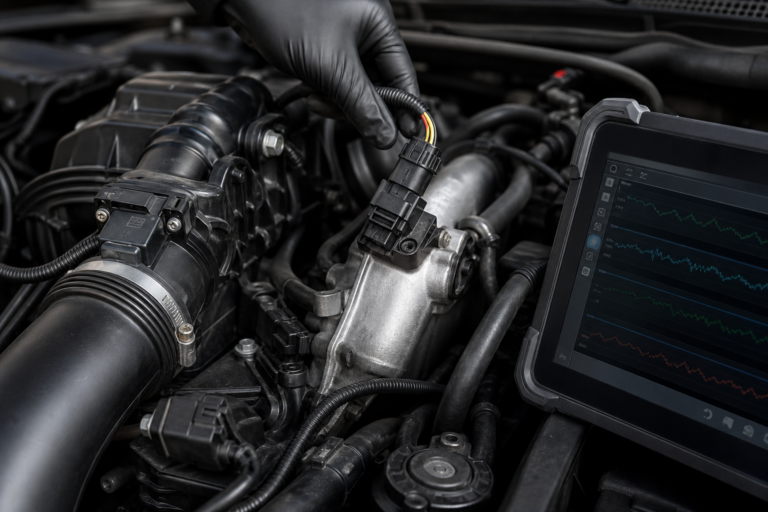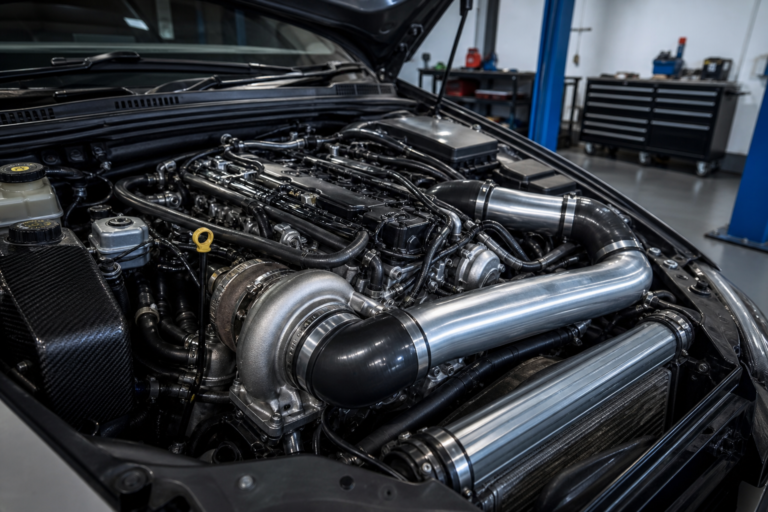
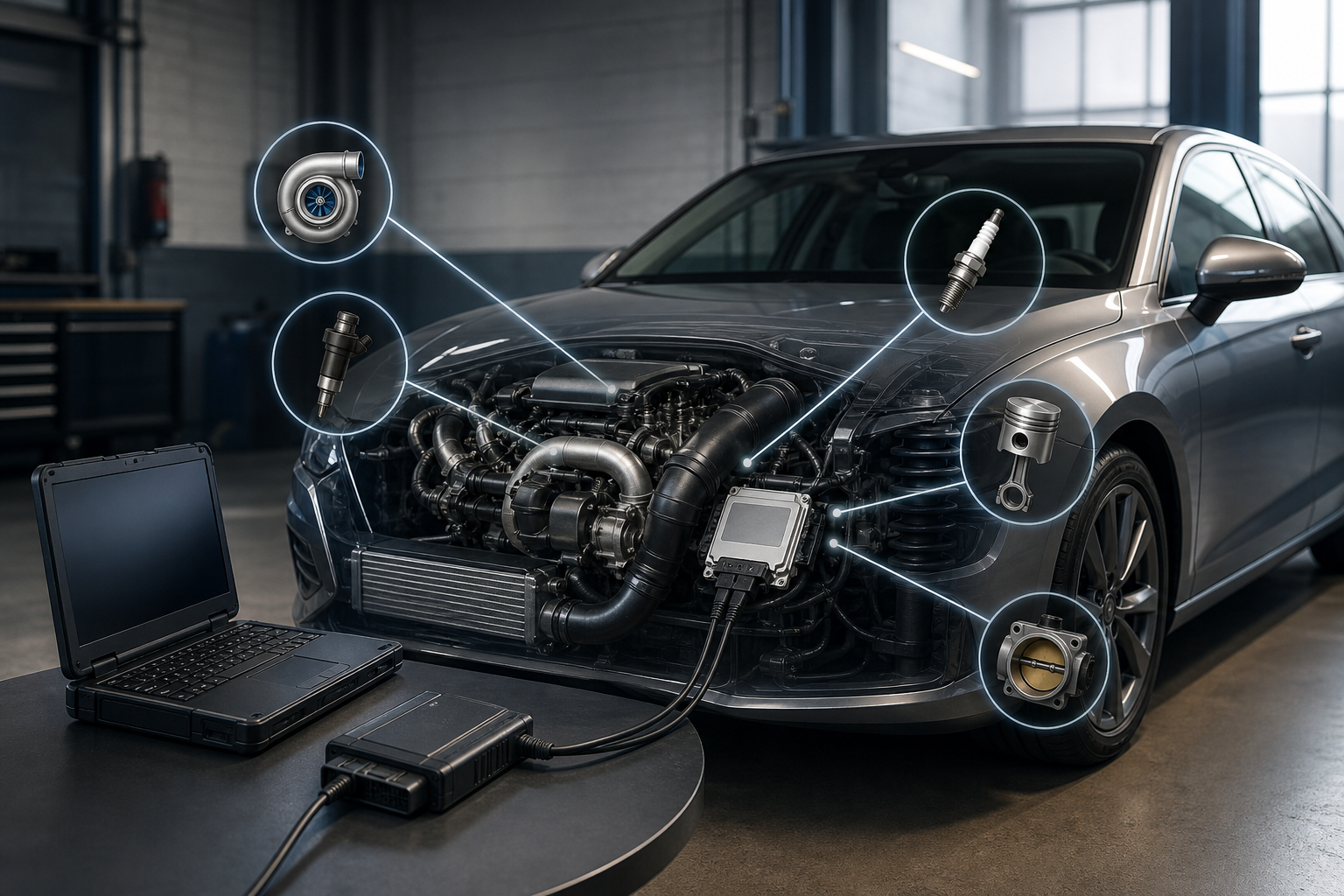
An ECU remap changes selected instructions within a vehicle’s engine-management software. Depending on the engine and ECU, these instructions may govern requested torque, turbo boost, fuelling, ignition or injection timing, throttle response and various operating limits.
A remap does not simply turn up one setting, nor does it physically change the engine. Modern ECUs use interconnected calibration tables, commonly called maps, to decide how the engine should respond under different conditions. Changing one area can affect several others, which is why an appropriate calibration must be developed around the specific vehicle, its hardware, fuel, condition and intended use.
What is an ECU map?
The engine control unit, or ECU, receives information from sensors throughout the vehicle. Depending on the model, these can monitor accelerator position, engine speed, air temperature, coolant temperature, airflow, intake pressure, exhaust oxygen levels and many other conditions.
The ECU processes this information and controls outputs such as fuel injection, ignition, turbocharger control and electronic throttle movement. It does this using calibration tables and logic written for the engine.
A map is best understood as a set of instructions covering a particular part of engine operation. Instead of containing one fixed value, it can specify different targets for different combinations of engine speed, load, temperature, gear or accelerator position.
An ECU remap reads and modifies relevant calibration data before writing the revised file back to the control unit. The exact areas available depend on the ECU, engine and vehicle architecture.
The main settings an ECU remap may change
| Calibration area | What it controls | What the driver may notice |
|---|---|---|
| Torque request | How much engine torque is requested for a given accelerator position | Stronger or smoother response at part and full throttle |
| Torque limits | The maximum permitted output under particular conditions | More usable torque where the vehicle can safely support it |
| Boost control | Turbocharger pressure targets and control behaviour | Stronger acceleration and a different torque curve |
| Fuelling | The amount and, on some engines, timing or pattern of injected fuel | Changes to power delivery, combustion and response |
| Ignition timing | When the spark occurs in a petrol engine | Improved torque and response when correctly matched to fuel and conditions |
| Throttle calibration | How pedal movement translates into throttle or torque demand | A sharper, softer or more progressive pedal feel |
| Protection and temperature limits | How output is restricted when operating conditions require protection | Usually little difference in normal driving, but important for reliability |
Torque requests: what your accelerator pedal is really asking for
In many modern vehicles, pressing the accelerator does not directly open the throttle or command a fixed quantity of fuel. The pedal tells the ECU how much performance the driver is requesting.
The ECU then calculates an appropriate torque target. It may consider engine speed, gear, temperature, traction-control intervention, gearbox requests and numerous mechanical or emissions-related limits before deciding what to deliver.
A remap can alter the relationship between pedal position and requested torque. For example, the calibration might request more torque in the middle of the pedal’s travel or make the response build more progressively.
This is one reason two cars with similar peak power figures can feel very different on the road. The shape and accessibility of the torque delivery often matter more during everyday driving than the headline maximum.
Torque limiters: the ECU’s internal boundaries
Modern engine management commonly includes several torque or fuel-quantity limits rather than one universal ceiling. Limits may vary with engine speed, gear, intake temperature, coolant temperature, exhaust temperature or atmospheric conditions.
These boundaries help coordinate the engine with the clutch, automatic gearbox, traction systems and emissions controls. A performance remap may revise selected limits so that the ECU can request and deliver additional output.
That does not mean every limiter should be removed or set to an unrealistically high value. Some limits protect hardware or reduce output when conditions become unsuitable. A sensible calibration works with the vehicle’s control strategy rather than indiscriminately disabling its safeguards.
Boost pressure: changing how a turbocharged engine breathes
On a turbocharged engine, a remap may change requested boost pressure and the way the ECU controls the turbocharger’s wastegate or variable-geometry mechanism. More suitable airflow can allow the engine to burn more fuel efficiently and produce additional torque.
Boost control is not simply a matter of entering a higher number. The ECU may use target tables, control duty tables, feedback corrections and limits based on temperature, engine speed or turbocharger operation.
The hardware still sets the physical boundaries. The turbocharger, intercooler, fuel system, engine internals and exhaust arrangement must all be considered. Software cannot safely make a small turbo flow unlimited air, and excessive boost can increase heat, cylinder pressure and turbocharger speed.
Fuelling: supplying the right amount at the right time
Fuelling calibration determines how much fuel is delivered under different operating conditions. The required changes differ significantly between petrol and diesel engines.
Petrol engines
On a petrol engine, the tuner may adjust fuelling targets under load to support the required combustion, temperature control and power output. The ECU may also use feedback from oxygen sensors to make short- and long-term corrections during relevant operating conditions.
Too little fuel under high load can create unsafe temperatures or increase the risk of damaging combustion. Excessive fuel is not a shortcut to safe power either; it can reduce performance, increase consumption and create other mechanical or emissions problems.
Diesel engines
Diesel calibration can involve injected fuel quantity, injection pressure and the timing or number of injection events, depending on the system. The ECU must coordinate this with available airflow and turbocharger control.
Adding fuel without sufficient air can produce excessive smoke and raise exhaust temperatures. Proper calibration therefore requires balance rather than simply increasing the permitted injection quantity.
Ignition and injection timing
In a spark-ignition petrol engine, ignition timing determines when the spark plug fires relative to piston movement. Correct timing helps the engine produce useful cylinder pressure at the appropriate point in the combustion cycle.
Ignition requirements vary with load, engine speed, air temperature, fuel quality and engine design. Advancing the timing is not automatically better. Excessive advance can cause knock, leading the ECU to reduce timing and, in more serious circumstances, increasing the risk of engine damage.
Diesel engines do not use spark ignition, but the timing of fuel injection remains important. Changes can influence torque, combustion noise, exhaust temperature and emissions. The correct approach depends on the injection system and the manufacturer’s underlying control strategy.
Throttle response: why a remapped car can feel faster immediately
Electronic throttle systems allow the ECU to decide how a pedal input should translate into throttle movement or requested torque. A remap may make this relationship more responsive, particularly at low and medium pedal positions.
A sharper pedal can make a vehicle feel livelier even if peak power is unchanged. However, very aggressive throttle calibration can make smooth driving difficult, especially in wet conditions, heavy traffic or a powerful front-wheel-drive vehicle.
Good throttle calibration should suit the vehicle’s purpose. A daily-driven van may benefit from predictable, progressive delivery, while a performance car may suit a more immediate response. Sharpness alone is not evidence of a better remap.
How the torque curve can change
A useful remap is not only about the highest power figure. It can change where torque arrives, how quickly it builds and how long the engine maintains useful output.
Depending on the vehicle, the revised calibration might:
- increase mid-range pulling power;
- reduce hesitation during acceleration;
- make overtaking response more immediate;
- smooth an uneven or abrupt torque delivery;
- maintain performance over a wider engine-speed range; or
- limit low-speed torque to protect traction or drivetrain components.
The most appropriate curve depends on the engine, turbocharger, transmission and use of the vehicle. A large low-revolution torque spike may produce an impressive initial shove, but it can also place unnecessary strain on a clutch or dual-mass flywheel.
Does an ECU remap change the gearbox?
An engine ECU remap and a gearbox remap are separate, although the two control units communicate on many modern vehicles.
The engine ECU may report calculated torque to the transmission, while an automatic or dual-clutch gearbox can request temporary torque reductions during shifts. If engine output is changed substantially, the gearbox calibration may also need to be considered.
A dedicated gearbox or DSG remap can modify supported functions such as shift strategy, torque limits, clutch-pressure targets and manual-mode behaviour. Exactly what can be changed varies by transmission. Drivers can explore the available tuning and vehicle software services before discussing what is suitable for their vehicle.
What an ECU remap does not change
Software changes do not replace maintenance or repair worn components. A remap does not physically enlarge the engine, upgrade the turbocharger, strengthen the clutch or improve the cooling system.
It also cannot make every vehicle produce the same percentage gain. Results depend on factors including:
- engine and ECU type;
- whether the engine is naturally aspirated, turbocharged or supercharged;
- factory calibration and available operating margin;
- fuel grade and quality;
- existing hardware modifications;
- engine, turbocharger and fuel-system condition;
- clutch or gearbox capability; and
- the vehicle’s normal workload and driving environment.
Published estimates should therefore be treated as vehicle-specific guidance rather than a universal promise. Owners can use the check gains facility as a starting point for model-specific information.
Can a remap improve fuel economy?
A calibration may improve low- and mid-range torque, allowing the driver to use a higher gear or less accelerator input in some situations. That does not guarantee lower fuel consumption.
Fuel use still depends heavily on speed, load, journey type, vehicle weight and driving style. If the extra performance is used frequently, consumption is likely to increase. Claims that every remapped vehicle will automatically deliver major fuel savings should be treated cautiously.
Why the vehicle’s condition matters
A remap increases what the engine is being asked to do, so existing faults should not be ignored. Problems involving boost leaks, injectors, ignition components, sensors, cooling, the clutch or emissions systems can affect the result and may become more noticeable under additional load.
Before proceeding, it is sensible to establish that the vehicle is mechanically suitable and free from relevant unresolved faults. Owners should also explain any hardware changes, previous software work, warning lights or drivability problems rather than assuming a remap will fix them.
Fault diagnosis and performance calibration are different tasks. Altering software to conceal a mechanical or emissions-related problem does not repair its cause.
Road legality and emissions equipment
A road-going remap must be considered alongside emissions, noise, roadworthiness and insurance requirements. The current DVSA MOT inspection manual lists manufacturer-fitted emissions equipment that is missing, obviously modified or defective as a major defect. Evidence of DPF tampering is also a major defect.
The Department for Transport states that the legality of a hardware or software modification depends primarily on how it affects the standard to which the vehicle was legally built. Its 2026 in-use emissions consultation specifically discusses software changes that manipulate DPF, catalyst, AdBlue/SCR or EGR operation.
Drivers should ensure that a modification remains suitable for lawful road use and should check the requirements of their insurer before proceeding. Track-only or off-road requirements should be discussed separately rather than assumed to be appropriate for a road vehicle.
What should remain protected after a remap?
Although strategies differ between manufacturers, modern ECUs may reduce output in response to excessive temperature, detected knock, overboost, inadequate fuel pressure or other unsafe operating conditions.
A responsible calibration should account for the ECU’s protection logic and the mechanical limits of the vehicle. Ask what has been adjusted, whether relevant safeguards remain functional and whether the calibration is intended for the fuel and hardware fitted to the car or van.
Questions to ask before choosing a remap
- Is the calibration appropriate for my exact engine, ECU and transmission?
- What fuel grade will the vehicle require?
- Are there unresolved faults that should be repaired first?
- How will the existing clutch or gearbox cope with the revised torque?
- Are factory emissions systems and protective strategies being retained?
- Is the map intended for a standard vehicle or particular hardware upgrades?
- Can the original software be restored if required?
- Do I need to tell my insurer about the modification?
The short answer
An ECU remap changes the software targets and limits used to control engine output. Depending on the vehicle, that can include requested torque, boost pressure, fuelling, ignition or injection timing, throttle response and the way torque is managed through the rev range.
The settings are interconnected, so a remap should not be treated as a generic file or a single boost adjustment. The right changes depend on the vehicle’s engine, transmission, hardware, condition, fuel and intended use.
For vehicle-specific advice in Sunderland, contact Limited Edition Tuning with the make, model, engine, transmission and details of any existing modifications. You can also read more practical explainers in the tuning blog.