Torque versus horsepower after a remap is not a choice between two competing benefits. Horsepower is one unit used to express power, alongside PS and kW. Torque and power are connected, but they describe different parts of the driving experience. Torque influences the twisting effort available at the engine; power combines torque with engine speed. In practice, the important question is where the additional output sits in the rev range and how the transmission uses it.
UK guidance: the MOT, towing and insurance points in this article relate to UK vehicles and drivers.
A well-suited remap may make a vehicle feel easier to drive at normal road speeds, better able to maintain speed on an incline or more decisive during an overtake. It may also make little difference where traction, gearing, a downshift strategy or vehicle load is the limiting factor.
Torque and power in plain English
| Term | What it describes | What it can mean on the road |
|---|---|---|
| Torque | Rotational or twisting force at the engine. | How readily the engine can pull at a particular rpm and in a particular gear. |
| Power (bhp, PS or kW) | The rate at which work is done. In a rotating engine, it depends on torque and engine speed. | How strongly the vehicle can keep accelerating as rpm and road speed rise. |
| Torque curve | Torque available across the rev range, rather than one peak number. | The shape and strength of the pull in everyday driving. |
| Power curve | Power available across the rev range. | Whether acceleration carries on strongly towards the top of a gear. |
Torque is normally quoted in Newton metres (Nm). Power may be shown as bhp, PS or kW; “horsepower” is therefore a way of quoting power, not a separate physical quantity. At a given rotational speed, more torque produces more power. At a given torque level, power rises as engine speed rises. This is why a single peak Nm or power figure cannot fully describe how a vehicle will feel.
How engine torque becomes wheel torque
The engine does not push the car along directly. The gearbox and final drive multiply engine torque before it reaches the wheels. A useful simplified calculation is:
Wheel torque ≈ engine torque × gear ratio × final-drive ratio × drivetrain efficiency
For example, an engine producing 300 Nm in a gear with a 3.0:1 ratio and a 4.0:1 final drive could deliver approximately:
300 × 3.0 × 4.0 × 0.90 = 3,240 Nm at the wheels
The 0.90 factor allows for a simplified 10% drivetrain loss. The exact figure varies by vehicle, drivetrain and conditions, but the principle is useful: lower gears multiply torque more strongly. Wheel force also depends on tyre radius, because the wheel torque is applied through the tyre contact patch.
This explains why changing down can make a car accelerate harder even if the engine’s peak torque has not changed. The trade-off is that the engine reaches higher rpm sooner, so an upshift follows earlier. Gearing therefore matters as much as an isolated engine-output figure.
Why the same peak torque can feel different
Imagine two engines that both claim a peak of 400 Nm. Engine A produces roughly 380 to 400 Nm from 1,800 to 3,000 rpm. Engine B reaches 400 Nm only at 4,000 rpm and produces substantially less at 2,000 rpm.
In a higher gear at everyday road speed, Engine A is likely to feel more responsive because it is already close to its strongest torque range. Engine B may feel less eager until the driver changes down. Put Engine B in a lower gear, however, and the higher engine speed may place it near its peak torque and stronger part of the power curve, changing the result completely.
The headline figure is identical, but the torque-curve shape and chosen ratio are not. That is why a before-and-after graph and an understanding of the intended use are more valuable than comparing peak numbers alone.
What you might feel after a remap
Overtaking from a rolling speed
Picture joining an A-road at 40 mph or accelerating past slower traffic where it is safe and legal to do so. If a remap adds useful torque in the rev range used by the current gear, the vehicle may feel more willing before a downshift is needed. Some drivers may also perceive that they need less throttle movement for the same response, but that is a drivability impression rather than a fixed or measurable outcome.
That outcome is not automatic. In an automatic vehicle, the transmission may already select a lower ratio that places the engine closer to its strongest power range. In that case, the change may be felt more in the rate of acceleration after the downshift than in avoiding it. In a manual, the result depends heavily on the gear the driver selects.
As speed builds, the power curve becomes more important. A vehicle can feel noticeably stronger at the beginning of an acceleration run yet feel less impressive later in the gear if available power falls away quickly.
Hill climbing
On a long incline, a broad torque curve can make it easier to maintain road speed in the selected gear at modest rpm, provided the engine has sufficient power for the gradient, speed and load. This is why the vehicle may feel less strained without suggesting that torque alone determines its hill-climbing ability.
If the hill steepens or road speed rises, a downshift may still be the right response. Selecting a lower gear increases wheel torque and raises engine rpm, which can also place the engine in an area of greater power. A remap cannot remove the basic effects of vehicle mass, gradient, tyre grip and aerodynamic resistance.
Towing and carrying weight
For a tow vehicle or working van, predictable delivery is often more useful than an abrupt peak. A smooth increase through the middle of the rev range can make pulling away, merging and climbing easier to judge.
However, a trailer, passengers or payload increase the work the vehicle must do. The vehicle and trailer must remain within the applicable towing and gross train weight limits, normally shown in the handbook, specification information or on the vehicle identification plate. Consider the intended load, clutch or transmission condition, cooling system and maintenance history before choosing a calibration for regular heavy-duty use.
Why the gearbox changes the practical result
Manual gearbox: the driver chooses the engine speed
With a manual gearbox, you decide whether to use a higher gear for relaxed progress or change down to access more wheel torque and higher engine speed. A fuller mid-range may make the higher-gear option more usable in some situations, but it does not replace the benefit of selecting an appropriate gear for a safe overtake or a steep hill.
Automatic gearbox: the shift strategy matters too
An automatic gearbox decides when to downshift and upshift according to its own control strategy, throttle position, vehicle speed and other inputs. Therefore, engine gains may feel different from one vehicle to another even where the headline figures look similar.
For compatible vehicles, gearbox calibration can be relevant because engine torque delivery and shift behaviour work together. A transmission’s torque limits and shift logic should be considered alongside any engine software changes.
Read the curves, not just the peaks
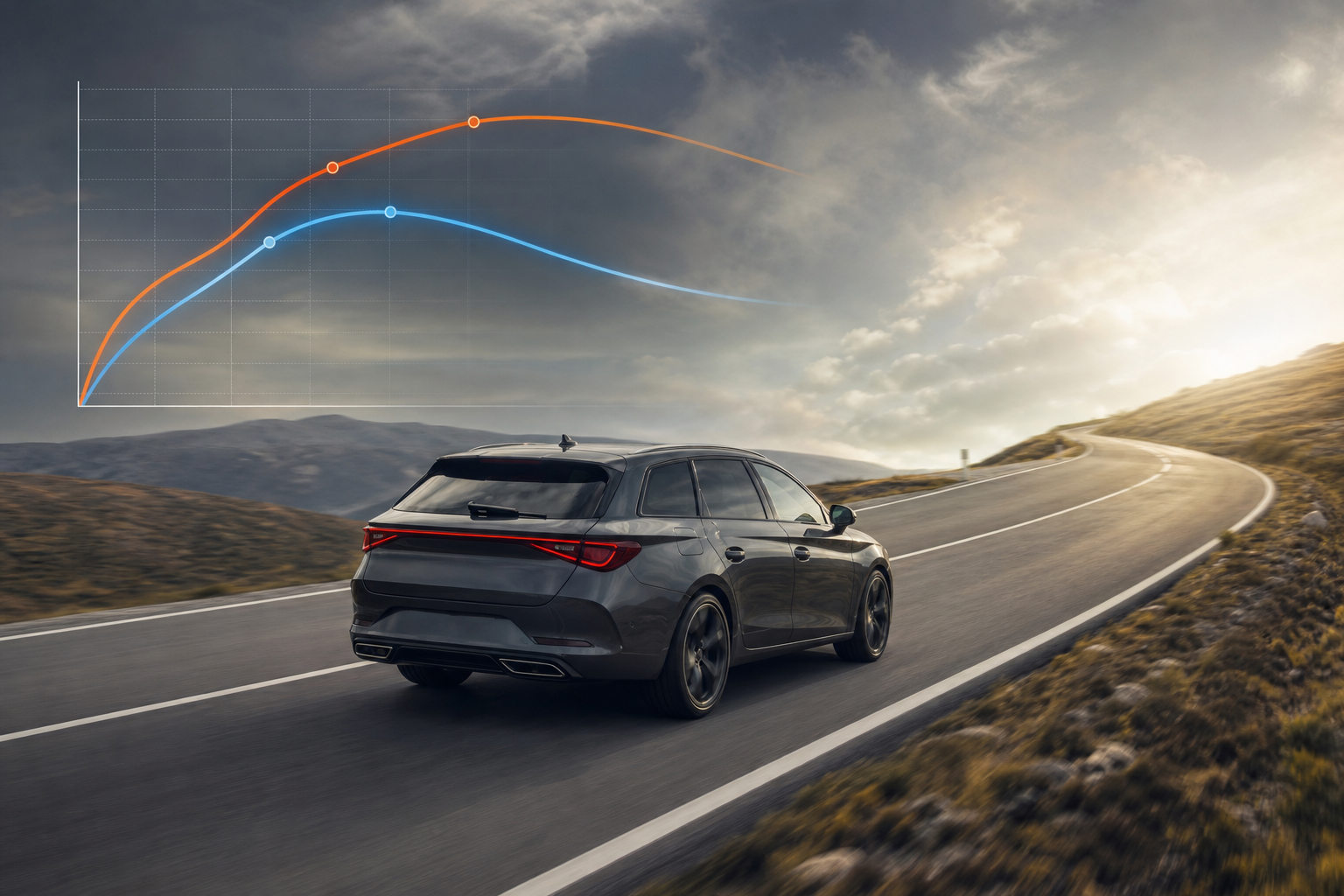
A before-and-after graph is more informative than a peak-power claim alone. Look for the rpm range used during the driving you actually do.
- Everyday commuting: a smooth, usable middle of the rev range may matter more than a brief maximum figure.
- Overtaking and motorway joining: consider both the mid-range response and whether power remains strong towards higher rpm.
- Towing or loaded work: prioritise progressive delivery and an approach that respects the vehicle’s mechanical limits.
- Enthusiastic road driving: a broader power curve may be more valuable than a sharp torque spike that fades early.
Two remaps can produce similar peak figures but deliver them differently. One may provide a broad increase across the middle of the rev range, while another may concentrate more of its change near a narrow peak. Neither is automatically better; the right choice depends on the vehicle, its gearbox and its intended use.
What determines the gains and the feel?
The engine type and hardware set the starting point. Turbocharged engines often, depending on the engine, supporting hardware and factory safeguards, offer more calibration scope than naturally aspirated engines. No two vehicles should be assumed to produce identical results. Fuel quality, intake-air temperature, existing faults, service condition, factory safeguards and transmission limits can all affect the available result.
Advertised figures should therefore be treated as vehicle-specific guidance rather than a promise. A sensible starting point is to assess the vehicle’s condition and intended use before software changes are considered.
A short UK MOT, emissions and insurance note
An ECU remap is not automatically the same thing as removing, bypassing or disabling emissions-control equipment. An ordinary calibration alone does not establish that a vehicle falls outside its approved emissions requirements; those are separate questions.
For an MOT, the DVSA inspection manual requires testers to inspect visible and identifiable emissions-control components. Manufacturer-fitted equipment that is missing, obviously modified or obviously defective can be a major defect, and the manual includes specific checks relating to DPF tampering. An MOT pass is a result of the inspection and emissions test at that time, not a general approval of every vehicle modification.
The position is different where an emissions-related modification, including removed or disabled equipment or a calibration that demonstrably causes the vehicle not to meet applicable emissions requirements, takes the vehicle outside the standards it is required to meet. That can have road-use and enforcement consequences beyond the MOT. Check the position for the specific vehicle and modification rather than assuming that an MOT result answers every legal question.
It is also sensible to contact your insurer before making changes, so you can confirm whether the modification affects the cover or policy terms.
Torque vs horsepower remap: the useful takeaway
Torque is most relevant to the pull available at a chosen engine speed and gear. Power, expressed in bhp, PS or kW, matters increasingly as acceleration continues and vehicle speed rises. Because the two are linked, the best remap is rarely the one with the largest isolated number.
Instead, assess the full torque and power curves, the gearbox, the vehicle’s condition and the way it is used. For a commuter, that may mean smooth response. For towing, it may mean controlled delivery under load. For faster road driving, it may mean power that remains useful through the rev range.
For vehicle-specific advice on likely drivability changes, suitable calibration and factors to check first, contact Limited Edition Tuning.