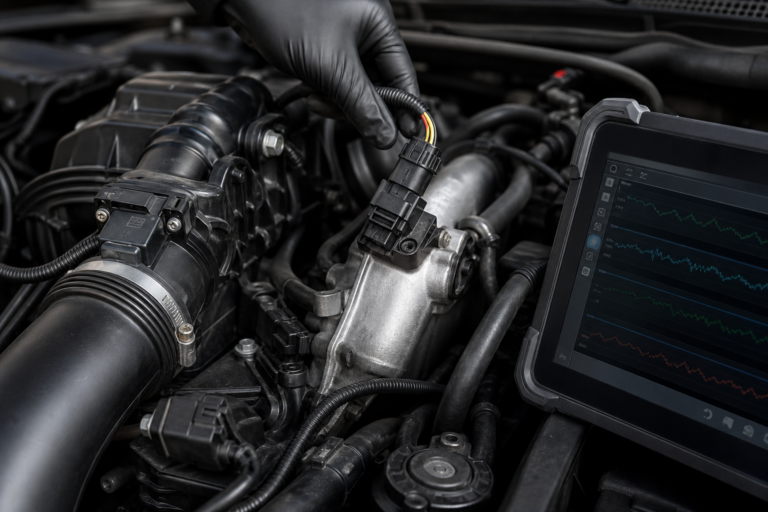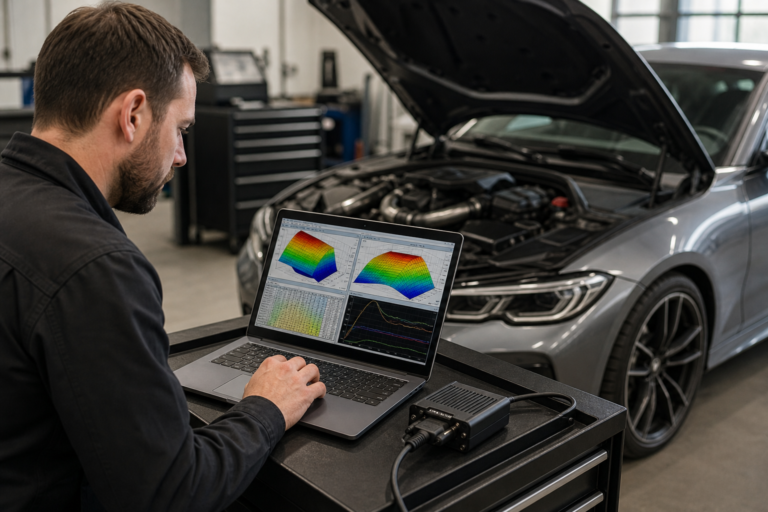

A turbo petrol remap can improve torque delivery, throttle response and usable performance because the ECU manages closely linked systems including boost pressure, ignition timing, fuelling, throttle requests and protective strategies. The objective should not be the highest boost figure. It should be a calibration suited to the engine’s fuel, temperature, fuel-system, turbocharger and mechanical limits.
For owners considering turbo or supercharged petrol tuning, the more useful question is not simply “how much power?” It is whether the vehicle can deliver repeatable performance on the fuel it will actually use, in its normal operating conditions, with its existing hardware.
Why turbo-petrol engines respond to remapping
A turbocharger uses exhaust energy to compress the intake charge. With suitable fuelling and combustion control, the additional air can support greater torque. A remap can refine how the ECU requests and controls that torque through changes that may include boost targets, wastegate control, ignition timing, fuelling targets, throttle behaviour and torque limiters.
Factory calibrations are generally developed with broad operating and durability requirements in mind. A modified calibration still needs to work with the vehicle’s existing control logic, thermal safeguards, traction systems and, where relevant, clutch or gearbox limits.
That is why two cars with the same engine may not produce identical results. Software version, mileage, fuel, intake-air temperature, supporting hardware and underlying condition can all differ. For a driver-friendly overview, see what an ECU remap actually changes.
Boost is only one part of the calibration
Increasing boost without considering combustion, fuel delivery and temperature is not a sensible tuning strategy. Compressing air raises its temperature, while increased load raises cylinder pressure. Both can reduce knock margin in a spark-ignition engine. Research on boosted spark-ignition engines identifies boost pressure, intake temperature and fuel characteristics as important factors in knock behaviour.
| Calibration area | Why it matters | What should be considered |
|---|---|---|
| Boost control | Determines the mass of air entering the engine. | Turbo operating range, charge temperature, wastegate control and requested torque. |
| Ignition timing | Has a major effect on torque, combustion timing and knock tendency. | Fuel grade, load, knock feedback and operating conditions. |
| Fuelling and lambda control | Supports the intended combustion strategy and, under some high-load conditions, may contribute to exhaust or component-temperature management. | Injector capacity, fuel pressure, lambda targets, emissions requirements and the engine’s thermal strategy. |
| Torque modelling | Helps engine, gearbox and stability systems interpret the requested output correctly. | Clutch or gearbox capacity, driveline protection and predictable drivability. |
| Thermal protection | Helps the ECU respond to high intake, coolant, oil or exhaust temperatures. | Consistent operation across repeated pulls and warm conditions, not one favourable run. |
A more restrained boost target with stable intake temperatures and sensible ignition control can be more useful than a higher peak figure that repeatedly loses timing or torque in warm conditions.
Knock control is protection, not permission to over-tune
Knock occurs when part of the unburned mixture auto-ignites rather than burning in the controlled manner intended by the spark event. In boosted petrol engines, higher pressure and temperature make knock an important constraint at medium and high load. Research on turbocharged gasoline direct-injection engines describes knock margin as a significant factor in the available efficiency and torque.
Modern petrol engines commonly use knock sensors and ECU strategies to detect abnormal combustion and adjust the engine’s operation. The exact response is vehicle-dependent: it may include changes to ignition timing and, depending on the calibration and operating conditions, other torque or load-management actions. Bosch explains the knock sensor’s role in detecting knock and enabling ignition adjustment.
These systems are intended to manage normal variation, such as a hotter day or fuel that is not quite as expected. They should not be treated as the main method of making an excessively aggressive calibration acceptable. Frequent timing correction under load is a reason to review the fuel, temperatures, mechanical condition and calibration rather than assuming the vehicle is performing consistently.
Why ignition timing matters
Ignition timing influences where combustion pressure occurs in the engine cycle. More advance is not automatically better: beyond the point the available fuel and conditions can support, knock risk rises. A well-judged turbo petrol remap prioritises a repeatable ignition strategy over a headline figure.
Fuel quality: document what the calibration expects
Octane rating indicates a fuel’s resistance to knock. If a calibration is specified for a minimum fuel grade, using a lower-octane fuel can reduce knock margin and may lead the ECU to reduce ignition advance or torque. Before booking, ask for the fuel requirement in writing: for example, whether the calibration is intended for 95 RON, 97 RON, 99 RON or another specified fuel.
In Great Britain, standard 95-octane petrol became E10 in September 2021. GOV.UK states that E5 ‘super’ petrol is 97+ octane and remains available at filling stations that sell two petrol grades. Check the vehicle handbook, filler-cap label and official compatibility guidance if there is any doubt about E10 suitability.
- Confirm the manufacturer’s requirements: check permitted fuel grades and ethanol compatibility before changing fuel.
- Get the tuning requirement documented: retain the tuner’s stated minimum RON requirement with the invoice or calibration record.
- Do not confuse ethanol content and octane: E5 and E10 describe the maximum ethanol content; the pump’s RON marking identifies octane grade.
- Use the specified fuel consistently: especially before logging, testing or sustained high-load use.
- Tell the tuner if fuel availability is a constraint: a calibration should reflect the fuel the car can realistically use, rather than an occasional premium fill-up.
A higher octane fuel does not automatically create more power on every standard calibration. The manufacturer’s requirements and the agreed calibration specification should come first.
Intake temperatures and heat soak affect consistency
Air discharged by a turbocharger is hotter than the air entering it. The intercooler removes part of that heat before the charge reaches the cylinders. In turbocharged spark-ignition research, intake-air temperature has been shown to affect knock-onset limits; other turbocharged-engine research also links higher intake temperature with a greater likelihood of abnormal combustion.
This helps explain why a turbo petrol car may feel strong during one cool, moving-road pull but less consistent after repeated acceleration runs, slow traffic or hot weather. Depending on the vehicle, the ECU may respond to temperatures and knock feedback by adjusting ignition timing, boost or requested torque.
That does not mean every vehicle requires an upgraded intercooler before a Stage 1 remap. It does mean the intended use matters. Daily commuting, towing, track use and repeated high-load motorway driving can place very different demands on the charge-air and cooling systems.
Signs heat management deserves closer attention
- Performance drops noticeably after repeated hard acceleration.
- The vehicle is used for track days, towing or prolonged high-load driving.
- There are existing cooling faults, coolant loss or temperature warnings.
- Hardware changes have increased airflow or boost demand.
- Pre- and post-calibration logs show high intake temperatures, repeated timing correction or lower achieved boost under load.
For a modified or hard-used car, the sensible next step may be improved charge-air cooling, supporting hardware or a more conservative calibration—not simply more boost.
Mechanical condition comes before extra torque
A remap cannot repair worn or faulty components. Additional torque and cylinder pressure can expose issues already present in the engine, turbocharger, fuel system, clutch, gearbox or driveline.
Before tuning, unresolved warning lights, misfires, boost leaks, oil leaks, cooling faults, excessive oil consumption and fuelling faults should be investigated. Service condition matters too: correct spark plugs, healthy ignition coils, suitable engine oil and a clean air filter all support dependable operation.
Pre-remap checks worth discussing
- Diagnostic scan for current and historic fault codes
- Fuel trims, rail or low-pressure fuel data, and injector behaviour where the ECU and vehicle allow meaningful assessment
- Boost-system condition, including hoses, intercooler pipework and diverter or recirculation valves
- Ignition-system health, plus correct spark-plug specification and gap
- Cooling-system condition and stable operating temperatures
- Turbocharger condition, oil supply, smoke and abnormal noise
- Clutch, gearbox and driveline behaviour under load
Read Is Your Car Ready for a Remap? The Pre-Tuning Health Check Explained for a fuller pre-tuning checklist.
What validation and records should you request?
For commercial-investigation decisions, ask what will actually be checked rather than relying on a promised power figure. The answer will vary by vehicle and equipment available, but a clear process should explain what is inspected, what is logged and what would stop work from proceeding.
| Ask before booking | Why it is useful |
|---|---|
| Which diagnostic checks are included? | Clarifies whether stored faults and obvious drivability concerns are reviewed before calibration. |
| Which parameters can be logged on this vehicle? | Helps establish whether relevant data such as boost request versus achieved boost, intake-air temperature, ignition correction, lambda and fuel-pressure data can be reviewed where available. |
| How is the fuel requirement recorded? | Gives you a clear minimum fuel grade to follow after the remap. |
| What hardware is assumed by the calibration? | Prevents confusion where an intake, exhaust, intercooler, turbocharger or fuel-system modification changes the vehicle from the quoted specification. |
| What are the exclusions? | Sets expectations around unresolved faults, worn clutches, transmission limits, emissions-system issues, track use and unsupported modifications. |
| How is the outcome validated? | Clarifies whether road logging, rolling-road work or another appropriate method is used, and what each method can and cannot show. |
Road testing and, where available and appropriate, rolling-road testing can provide useful information under load. Neither replaces mechanical diagnosis, and a power graph alone does not prove long-term durability. See Rolling Road vs Road Tuning: How Remaps Are Checked.
Limits, warranty and long-term reliability
No remap can guarantee the life of an engine, turbocharger, gearbox, clutch or other drivetrain component. The practical limit depends on the specific vehicle, its condition, maintenance, fuel, operating temperatures, hardware, driving style and use. A calibration that is appropriate for an everyday road car may not be appropriate for repeated track use, towing or a vehicle with existing wear.
Software modification may also affect manufacturer warranty cover or the position of a warranty provider, and it can affect insurance obligations. Check your relevant warranty terms and tell your insurer about modifications. For more detail, see Do You Need to Tell Your Insurer About an ECU Remap?.
A responsible provider should be willing to explain the recommended hardware limits, fuel requirement, validation approach and any reasons the vehicle may not be suitable for tuning in its current condition.
Custom calibration versus a generic turbo petrol file
Turbo petrol cars can vary in software, hardware condition and real-world use. The exact ECU version, fuel requirement, modifications and intended use should all be considered, particularly where the vehicle has an aftermarket intake, exhaust, intercooler, turbocharger or fuel-system changes.
A vehicle-specific approach creates an opportunity to identify limitations and set realistic expectations. Learn more in Custom Remap vs Generic Tuning File: What Is the Difference?.
Choosing a suitable level of tuning
For a healthy, standard vehicle, Stage 1 is often used to describe a calibration intended for standard hardware. The label is not a universal technical standard, however, so ask exactly what it includes, the expected fuel grade and any hardware or condition requirements. More ambitious modifications may require supporting changes and a different approach to fuelling, heat management and drivetrain capacity.
Compare the trade-offs rather than focusing only on a headline number. Stage 1 vs Stage 2 Remapping: Which Level Suits Your Car? explains the usual distinctions, while this guide to Stage 1 remap gains explains why outcomes vary.
Practical checklist before booking a turbo petrol remap
- Confirm the vehicle is serviced and has no unresolved warning lights or drivability faults.
- Check the manufacturer’s fuel requirement and E10 compatibility where relevant.
- Decide which fuel grade you can use consistently after tuning.
- Describe how the vehicle is used: commuting, fast road, towing, track use or a mixture.
- Declare every engine, cooling, fuel-system and drivetrain modification.
- Ask which checks, logs and validation are included for your particular vehicle.
- Request the fuel requirement, hardware assumptions and exclusions in writing.
- Consider your responsibilities after modification, including insurance disclosure and vehicle-roadworthiness requirements. See Does ECU Remapping Affect Your MOT?.
Discussing your vehicle before remapping
Before committing to a turbo petrol remap, provide the vehicle registration or exact model details, mileage, service history, current modifications, usual fuel grade and intended use. This gives the tuner a better basis for explaining whether the current hardware is suitable, what should be checked first and what outcome is realistic.
Contact Limited Edition Tuning to discuss your vehicle, or review the available ECU remapping and tuning services.
Frequently asked questions
Will a turbo petrol remap require premium fuel?
It depends on the vehicle and the agreed calibration. Some calibrations are specified around a minimum premium-fuel grade to preserve knock margin. Use only the fuel grade stated by the tuner and permitted by the vehicle manufacturer.
Can hot weather reduce performance after a remap?
Yes. Higher intake-air temperatures can reduce knock margin, and the ECU may respond by adjusting ignition timing, boost or torque. Cooling-system condition, intercooler effectiveness and the vehicle’s intended use all affect consistency.
Is more boost always better on a turbo petrol engine?
No. More boost can also mean higher charge temperature and cylinder pressure. The sensible limit depends on the turbocharger, fuel system, available fuel, cooling capacity, knock behaviour, drivetrain and engine condition.
Which logs should I ask about before a turbo petrol remap?
Ask what data can be read reliably from your vehicle. Where available, useful areas may include fault codes, boost request and achieved boost, intake-air temperature, ignition correction, lambda and fuel-pressure data. The exact list is vehicle-dependent, so a provider should explain what can be assessed and what cannot.
Should I repair a minor fault before remapping?
Yes. Investigate faults before tuning, particularly misfires, boost leaks, cooling concerns, fuelling issues, warning lights and drivetrain slip. Extra torque can make an existing problem more obvious or more serious.