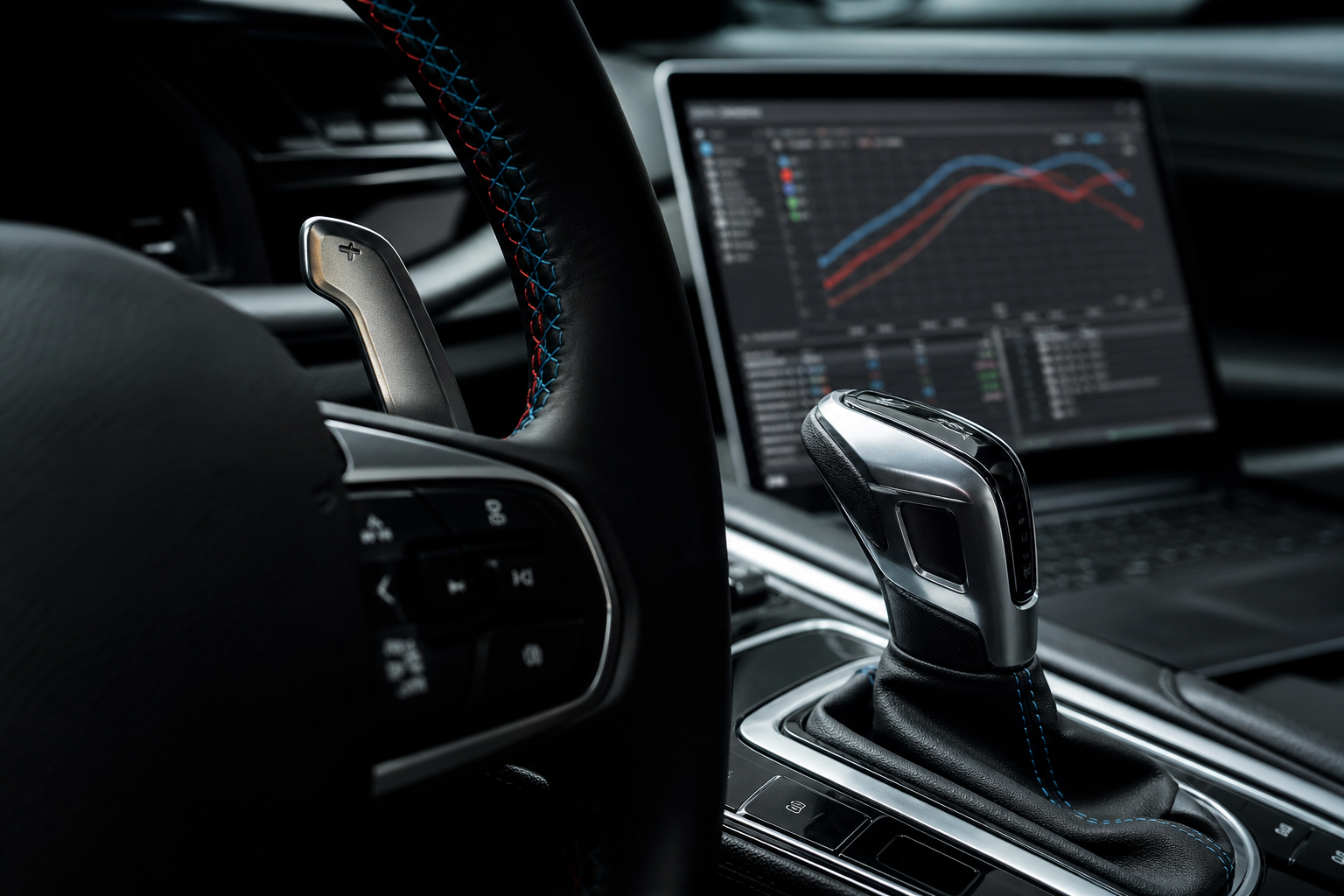
A DSG gearbox remap, often called a TCU remap, changes software in the transmission control unit rather than adding engine power by itself. On supported vehicles, it may alter selected transmission behaviours such as shift scheduling, torque-related calibration values and manual-mode options.
The important qualification is that there is no single “DSG tune”. Volkswagen Group has used several dual-clutch gearbox families, and the options available depend on the exact gearbox code, TCU hardware and software, engine setup, and the tuning platform used. A feature available for one DQ250 or DQ381 application, for example, should not be assumed to be available for another vehicle.
DSG is Volkswagen Group’s name for a dual-clutch transmission design. It uses two clutches to preselect gears, supporting rapid changes compared with a conventional single-clutch manual transmission. Volkswagen explains the DSG principle here.
DSG remap benefits at a glance
For a healthy, supported vehicle, a gearbox calibration may be considered for driveability or to complement an engine ECU remap. The possible benefits are calibration-dependent, not guaranteed outcomes.
| Potential area | What may be configurable | Why it matters |
|---|---|---|
| Automatic shift behaviour | Selected upshift and downshift scheduling in Drive or Sport | The gearbox may feel less eager to choose a high gear or more ready to downshift when acceleration is requested. |
| Torque-related calibration | Platform-specific torque limit or clutch-control settings | This can be relevant where an ECU remap materially changes the engine’s torque output. |
| Manual mode | Available rules for paddle requests, kickdown and automatic upshifts | The driver may have more consistent control, while sensible overspeed protection remains. |
| Shift response | Shift timing and response in defined operating conditions | The car may feel more direct during stronger acceleration. |
| Drive-mode distinction | The difference between comfort-oriented and sport-oriented schedules | Drive and Sport can feel more clearly differentiated where the file supports this. |
These are examples of functions offered by some TCU tuning platforms for particular DSG applications, not a checklist of changes that every vehicle can receive. For instance, APR documents different TCU options for specific DQ250, DQ381 and DL501 transmissions, including shift-point, torque-limit and manual-mode settings. Those product pages also show why compatibility has to be checked by gearbox family and vehicle application. See an example for the DQ381.
ECU remap versus TCU remap
An ECU remap changes engine-control calibration. Depending on the vehicle and file, that can affect areas such as boost control, fuelling, ignition timing, throttle response and torque delivery. A TCU remap changes the transmission controller’s calibration.
They can be assessed together because the engine and transmission exchange operating information on many modern platforms. However, the exact interaction, the factory limits involved and the need for a TCU remap are vehicle-specific. An ECU remap does not automatically mean that a DSG remap is necessary, and a TCU remap cannot make a transmission mechanically capable of handling any torque figure.
Ask for a proposed torque figure and a clear explanation of why the existing gearbox calibration is, or is not, suitable for your particular vehicle. For a broader explanation of engine software, read what an ECU remap actually changes.
How shift logic can change driveability
Factory automatic programmes are designed for a broad range of drivers and priorities, including refinement, fuel economy, emissions compliance and component protection. A TCU calibration may offer a different compromise for a specific engine setup and intended use.
On a compatible application, this may mean holding a lower gear for longer under load, avoiding an early upshift in certain conditions, or selecting a lower gear more readily when the driver asks for acceleration. Drivers sometimes describe the result as improved throttle response, but the accelerator-pedal map itself is normally an ECU matter; the perceived improvement may instead come from the gearbox choosing a more suitable ratio sooner.
A more aggressive shift schedule is not automatically better. A daily-driven road car still needs predictable low-speed behaviour and smooth manoeuvring. The right calibration should suit the vehicle’s engine characteristics, maintenance condition and normal use rather than simply making every shift firmer.
Torque limits: useful context, not a promise
Some transmission controllers use torque-related calculations and limits. On supported tuning platforms, a TCU calibration may revise relevant values to suit an engine that has been modified. APR, for example, describes raised non-physical transmission torque limits and increased clutch clamping pressure on selected DSG products, while retaining temperature-related intervention strategies. That describes its supported files, not a universal safe approach for all DSG gearboxes. Read the DQ250 product-specific example.
Raising or changing a software value does not upgrade worn clutches, improve fluid condition or erase the gearbox’s physical limits. The suitable approach depends on the exact transmission, service history, engine torque, cooling conditions and intended use. A credible tuner should explain what remains protected and should not present software as a substitute for mechanical capacity.
Manual mode and kickdown behaviour
Manual-mode behaviour is one of the most variable parts of DSG tuning. On some supported files, a tuner may be able to change whether the gearbox automatically upshifts near the rev limit, how it responds to a kickdown request, or how readily it accepts a paddle-requested downshift. On other TCU versions, those options may be unavailable, limited or deliberately retained.
Even where manual-mode options are available, protective intervention should be expected. A responsible calibration should still prevent a requested downshift that would take engine speed beyond a safe limit. Do not assume a remap will create a fully manual transmission experience, and do not request the removal of protections without understanding the consequences.
Identify the vehicle before discussing a DSG remap
A registration number is a useful starting point, but it is not enough to confirm tuning options. Before requesting a quote or booking, gather the following information:
- Vehicle make, model, year and registration number.
- Engine code, where available.
- Gearbox code or confirmed transmission family.
- Current ECU and TCU software status, including previous tuning work.
- Whether the car is standard or has hardware modifications.
- Recent gearbox servicing, fluid and filter history where applicable.
- Your intended use: commuting, towing, spirited road driving, track use or a mixture.
- Any current drivability issues, warning lights or stored fault codes.
This information helps establish whether software access is available and whether the proposed calibration is appropriate. It also prevents an unsuitable generic file being applied simply because two vehicles share the same model badge. Our guide to custom remaps versus generic tuning files explains why vehicle-specific assessment matters.
Symptoms that should stop tuning until diagnosed
A DSG remap is not a repair. Pause the tuning conversation and arrange diagnosis first if the vehicle has any of the following symptoms:
- Transmission warning lights, fault messages or stored gearbox codes.
- Slipping, flare in engine speed, shuddering or harsh clutch engagement.
- A significant delay selecting Drive or Reverse.
- Overheating warnings or a burning smell.
- Unusual noises, vibration or repeated limp-home operation.
- An uncertain service history, especially where a gearbox has a specified fluid and filter service requirement.
- Unexplained behaviour following previous engine or gearbox software work.
Volkswagen advises using the correct transmission oil and replacing transmission oil and filters at the relevant intervals for applicable gearboxes. Its service guidance also makes clear that gearbox types differ. See Volkswagen’s gearbox servicing information.
Questions to ask a DSG tuner
- Which gearbox code and TCU software version have you identified?
- Which changes are actually available for this vehicle, and which are not?
- Is the file designed for a standard engine or for my current ECU calibration?
- What torque level is being targeted, and what assumptions are being made about clutch condition?
- Which factory protection strategies remain in place?
- Will you carry out a diagnostic scan and review faults before flashing?
- How will the result be checked after calibration?
- What is the plan if the vehicle has a software lock, unsupported TCU or pre-existing issue?
A proper pre-tuning assessment is more valuable than a list of headline features. See our pre-tuning health-check guide for the checks that should come before calibration.
Insurance and road-use considerations
A DSG remap is a modification that may affect insurance terms and price. Requirements differ between policies and insurers, so disclose the modification before proceeding and obtain confirmation that the vehicle will remain covered on the terms you expect. The Association of British Insurers advises motorists to speak with their insurer and notes that modifications can affect insurance costs. Read the ABI’s guidance on motor insurance and modifications.
Keep all emissions-control equipment intact and ensure the vehicle remains safe, roadworthy and suitable for its intended use. For more detail, see our guide to declaring an ECU remap to your insurer.
Is a DSG remap right for your vehicle?
A DSG remap may be worth considering where the vehicle is healthy, the TCU is supported and you want the gearbox calibration assessed alongside an engine remap or your usual driving requirements. It is less suitable where faults are unresolved, servicing is overdue, previous software is unknown or the aim is to hide a mechanical problem.
Limited Edition Tuning can discuss DSG gearbox remapping with car, van and performance-vehicle owners in Sunderland and the surrounding area. The starting point should be identification of the gearbox, a condition check, a review of any engine modifications and an honest discussion of the result you want.
Contact Limited Edition Tuning to discuss your vehicle, or view the available tuning services.
Frequently asked questions
Will a DSG remap make my car faster?
A TCU remap does not normally create engine power on its own. On a compatible vehicle, it may change how the transmission applies the power already available. Any effect on acceleration depends on the engine setup, gearbox, calibration, traction and vehicle condition.
Do I need a DSG remap with a Stage 1 ECU remap?
Not necessarily. The answer depends on the vehicle, gearbox family, ECU file and requested torque. A tuner should assess the complete setup rather than treating a TCU remap as compulsory for every Stage 1 vehicle.
Can a DSG remap remove automatic upshifts in manual mode?
Possibly, but only on some gearbox and tuning-platform combinations. It is a calibration-specific option, not a standard feature of all DSG remaps. Protective downshift limits should remain.
Can a DSG remap fix a jerky or slipping gearbox?
No. Jerking, slipping, warnings, delayed engagement and unusual noises need diagnosis before tuning. They may indicate a servicing, adaptation, electrical or mechanical problem that software alone cannot solve.