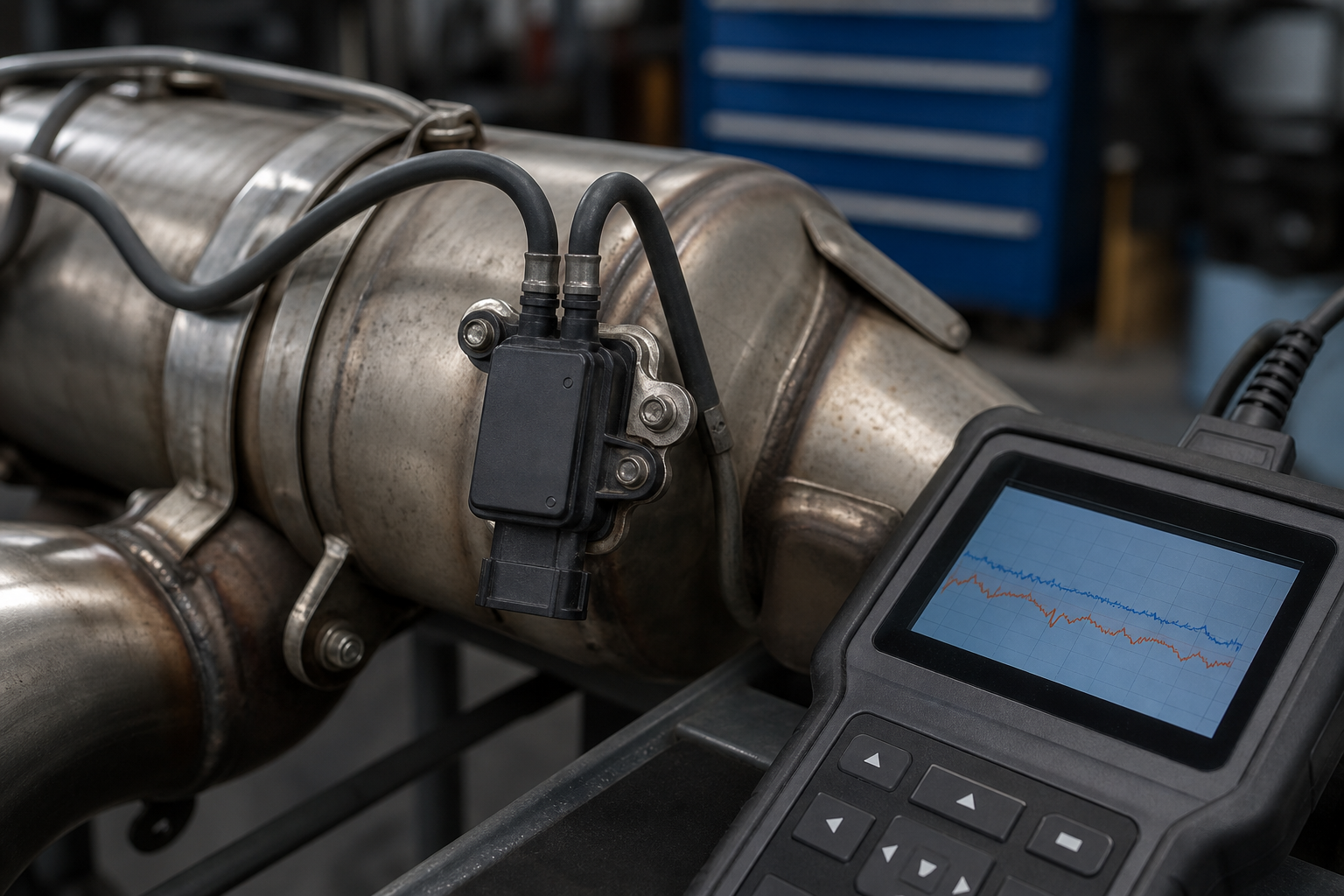
DPF differential pressure sensor diagnostics should begin with context, not one number on a scan tool. The sensor measures the pressure difference between the inlet and outlet sides of the diesel particulate filter (DPF) and sends that information to the engine control unit (ECU). The ECU can use it as part of DPF monitoring and regeneration calculations.
A high, low or implausible value does not identify the failed part on its own. DPF restriction can increase the pressure difference, but blocked pressure hoses, obstructed take-off points, wiring faults, an exhaust leak or a sensor fault can also produce misleading data. HELLA’s exhaust-aftertreatment guidance describes the sensor’s upstream/downstream measurement role and its use in regeneration calculations.
What the sensor measures — and what it does not
A DPF differential pressure sensor normally has two pressure connections: one upstream of the DPF and one downstream. It reports the difference between those pressures. It does not directly measure soot mass, ash mass or the physical condition of the filter.
As exhaust flow rises, the pressure difference across a restriction may rise too. Soot loading can contribute to restriction, while ash remains in the filter after normal regeneration and can add to longer-term flow resistance. Depending on the vehicle, the ECU may also use other sensor inputs and calculated values.
There is no universal differential-pressure reading that proves a DPF is either blocked or healthy. A meaningful result depends on the manufacturer’s specified engine speed, temperature, test conditions and diagnostic procedure.
Important: vehicle-specific testing is essential
This article explains general diagnostic principles, not a test specification for every vehicle. Sensor designs, hose routing, wiring pin-outs, expected signal values, safe pressure-test connections and regeneration conditions vary by make, engine and ECU strategy.
Use the manufacturer’s repair information and approved equipment for the vehicle being tested. Do not treat generic voltage figures, pressure values or improvised exhaust connections as pass-or-fail tests.
Why the same reading can mean different things
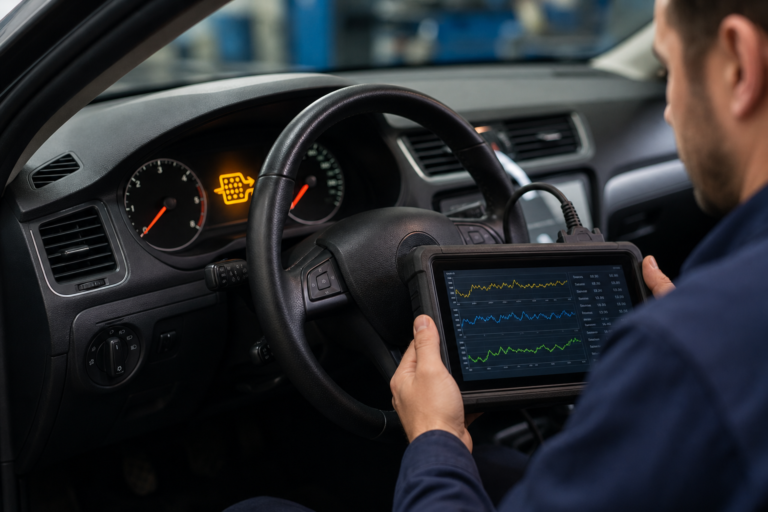
Live data is most useful when recorded with the operating conditions beside it. Note engine speed, relevant temperatures, stored fault codes and whether regeneration is active, recently completed or unavailable.
On a sound system, displayed differential pressure would generally be expected to respond as engine speed and exhaust flow increase. For example, a reading at approximately 2,000 rpm may be higher than at hot idle. That is an expected direction of change, not a universal specification: the acceptable amount of change differs between vehicles.
A value that remains fixed as conditions change can be significant. It may indicate that the sensor is not receiving a representative pressure signal, rather than proving filter restriction.
Practical interpretation of suspect readings
| What is observed | What it could indicate | Useful next checks |
|---|---|---|
| A higher-than-expected value under the manufacturer’s specified conditions | Filter restriction, ash accumulation, a restricted hose or take-off point, or an inaccurate sensor signal | Check related codes, repeat live-data checks under controlled conditions and inspect both pressure paths |
| A very low, zero or fixed value as engine speed changes | A disconnected, split, melted, blocked or incorrectly routed hose; blocked take-off point; wiring or sensor concern | Inspect hoses and connections, then follow vehicle-specific circuit and plausibility checks |
| A pressure-related code returns after being cleared | An unresolved circuit, signal, hose or exhaust-system fault | Save fault codes and freeze-frame data before clearing them again, then investigate related faults |
| The reading remains implausible after a completed regeneration | Remaining restriction, ash loading, a pressure-path issue or inaccurate sensor data | Repeat the manufacturer-specified comparison before deciding whether any component is faulty |
Common causes of misleading pressure data
Blocked or damaged pressure hoses
The hoses between the sensor and exhaust are part of the measurement system. They can become heat-damaged, split, kinked, disconnected or internally restricted. Deposits can also obstruct a hose or a metal pressure take-off point.
These faults can create a false high, false low or static reading. Delphi’s DPF sensor guidance recommends inspecting the electrical connection and hoses for damage or blockages before condemning the sensor.
Electrical connection or wiring faults
The sensor depends on a sound power supply, earth and signal circuit. Check accessible connectors and wiring for heat damage, chafing, corrosion, water ingress or insecure terminals. Any circuit checks should use the manufacturer’s wiring information and stated method.
Exhaust leaks and related faults
An exhaust leak can affect the pressure relationship being measured. Delphi notes that an exhaust leak can set DPF differential-pressure sensor-related codes. Engine or aftertreatment faults that prevent normal combustion or regeneration can also contribute to DPF symptoms.
Scan-tool live data versus direct pressure testing
These checks answer different questions.
| Check | What it assesses | Main limitation |
|---|---|---|
| Scan-tool differential-pressure live data | The value the ECU receives from the vehicle’s sensor system | The displayed value can be misleading if the sensor, wiring, hoses or take-off points are faulty |
| Direct mechanical pressure or back-pressure test | Physical pressure at manufacturer-approved exhaust test points | It requires suitable equipment, safe connection points and the vehicle-specific procedure |
A direct test may help a suitably equipped technician compare the physical system with the ECU’s reported value. It is not a DIY substitute for scan data. Exhaust parts can be extremely hot, and unsuitable or improvised connections can cause injury, component damage or exhaust leaks.
A sensible order before replacing parts
1. Record fault information first
Read stored diagnostic trouble codes and save freeze-frame data where available. This may show the engine speed, temperatures and other conditions present when the ECU detected the fault.
2. Compare live data under repeatable conditions
Use the manufacturer’s required conditions. Readings captured at different temperatures, engine speeds or regeneration states are not necessarily comparable.
3. Inspect the full pressure path
Check hose routing, security and visible condition, along with accessible pressure take-off points. The sensor cannot provide reliable data if one pressure path is blocked, disconnected, leaking or incorrectly connected.
4. Follow the vehicle-specific electrical test procedure
Where required, verify the reference supply, earth and signal behaviour using the correct vehicle information. Avoid generic pin-outs and voltage targets because sensor arrangements differ.
5. Compare the evidence before condemning a component
Assess the fault memory, live data, pressure paths and electrical checks together. This reduces the risk of replacing a sensor or DPF solely because a scan tool displayed an unusual value.
Why diagnosis should come before software decisions
A warning light, failed regeneration or implausible pressure reading is evidence to investigate, not a diagnosis by itself. Software changes cannot establish whether the DPF, sensor, pressure hoses, wiring or another engine fault is responsible for the symptoms.
There are also MOT implications for UK road vehicles. The current DVSA MOT manual states that visible and identifiable manufacturer-fitted diesel emissions-control equipment that is missing, obviously modified or obviously defective is a major defect. Evidence that a DPF has been tampered with is also a major defect. Separately, during the diesel opacity test, vehicles fitted with a DPF must not emit visible smoke from the exhaust during the metered check. Read the current GOV.UK MOT inspection manual, section 8.2.2.
These criteria do not mean every DPF-related fault code automatically causes an MOT failure. They do reinforce the value of diagnosing the underlying fault before making decisions about parts or software.
When to seek help
Further assessment may be appropriate where there are recurring DPF or engine warnings, reduced power, repeated pressure-sensor codes, readings that do not respond plausibly to engine speed, or regeneration that will not complete.
To discuss a DPF-related concern with Limited Edition Tuning, provide the vehicle make, model, engine, model year, exact fault codes and any scan-tool screenshots. Recent repair history and a clear description of the symptoms can also make an initial enquiry more useful. The site’s DPF information page is also available to review.
Frequently asked questions
Can a blocked pressure hose cause a DPF sensor fault code?
Yes. A blocked, split, disconnected or heat-damaged hose can give the sensor an inaccurate pressure signal and may cause an implausible reading or related fault code.
Does a high differential-pressure reading always mean the DPF is blocked?
No. It can indicate restriction, but the pressure hoses, take-off points, sensor, wiring and exhaust system must also be considered using the manufacturer’s procedure.
Does completed regeneration prove the DPF and sensor are healthy?
No. A completed regeneration does not independently confirm that the sensor is accurate, the pressure path is clear or that ash-related restriction is absent.
Can I check DPF back pressure by removing a hose myself?
It is not advisable. Direct pressure testing should use approved test points, suitable equipment and the manufacturer’s safety procedure.